How WOKE Hawai'i Triggered the Rise of MAGA and Donald J Trump
On August 24, 2025, Eric Stinton (CivilBeat), posed this question in his column, "Can Settlers Ever Be Pono In Hawai'i?" Eric asked two local Native Hawaiians / Kanaka Maoli. One Hawaiian cultural expert thinks unity among all cultures is possible. Another says no way. Scott Goold objects. Eric didn't include a representative of the White American population in the islands. Scott now demands equal time and challenges the two brothers to a professional debate.
White Americans should NOT be made to feel guilty for living in the 50th state in the United States of America. Such action violates the principles of aloha and respect for others. Scott Goold addresses the comments made by Elijah Kalā McShane and Adam Keawe Manalo-Camp below, and invited both brothers to have a public debate with me. Neither accepted Scott's challenge.Let's TALK about Kamehameha Schools Admission Policy and Lack of Civility by Native Hawaiians, "Go Home Haole!" Backlash to the lawsuit has been ferocious. Scott Goold received death threats. Lead attorney in the case had his home address posted on social media and a package that appeared to contain feces mailed to his front door. Others have suggested that the founder of the nonprofit leading the lawsuit should be assassinated like Charlie Kirk. [MORE]
Scott Goold and Hawk Devi TALK about Kamehameha Schools Admission Policy [MORE]
Scott Goold DEBATES Kamehameha Schools Admission Policy with Native Hawaiians [MORE]
Scott Goold, PhD work at University of New Mexico in political science and economics, focused on strengthening democracy and increasing equality. Scott's upcoming book details America's collapse into tribalism motivated directly by the political and social movements in the U.S. 50th state of Hawai'i. The Aloha state's WOKE agenda spread across the mainland, fueled MAGA and led to the rise of Donald J Trump.
Excerpts of Dr. Goold's book, Becoming Tribal: How WOKE Hawai'i Triggered the Rise of MAGA and Donald J Trump are published here for advanced review. [DOWNLOAD Prologue]
Elijah Kalā McShane
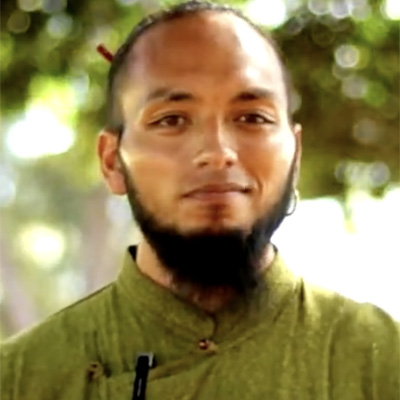
Elijah Kalā, also known as Son of O'ahu, is a devoted Ambassador of Aloha from the sacred islands of Hawai'i. His mission of sharing The Way of Aloha has reached millions around the world via his social media reach and his work as a demanded speaker, facilitator, and ceremonialist. Elijah's message focuses around 3 fundamental principles of Hawaiian spirituality: Aloha 'Aina (connection to the land), Aloha Akua (connection to spirit), & Aloha Kanaka (connection to one another).
I believe the Son of O'ahu spreads many Convenient Lies about island life and the people who live here. These attitudes divide and create disharmony — the opposite of aloha.
Elija told Eric, "The reason why I chose to use the word settler is because it clarifies to people who are moving to Hawai'i to accept that they are a settler, and that's OK. It's not a harmful term. We live in a world of globalization. If you're not from your ancestral homeland and you're going to another place, you're going to be a settler. Is that a bad thing? Maybe, maybe not."
Scott disagrees: Anthropologists suggest ALL human life began in Africa. Humans have been moving and relocating since the beginning of time. If a people moved to a new land, and were pioneers, then we generally say they SETTLED on that land. The islands in the Hawaiian archipelago pushed up from the ocean floor. All humans moved here from somewhere else. The initial Polynesians who arrived would therefore be SETTLERS in the islands — and first to lay down roots. Many left or disappeared. Every additional person: Polynesian, Asian, European, American were also settlers.
Possibly misunderstanding occurs here as Native Hawaiians do not really understand English words like "settle." In my life, I have resided for significant periods of time in five U.S. states: Mississippi, Idaho, California, New Mexico and Hawai'i. One use of the word "settle" would be to say I traveled all my life and finally settled in Hawai'i — meaning my final resting place.
Relieving Haole Guilt
Elija states, "I’m not for clearing a person’s conscience. That’s not my goal or intention." As a White American in Hawai'i, I harbor no guilt. My family felt no guilt relocating to Mississippi and then to Idaho. Moving to California and then New Mexico, I suffered no feelings of guilt. Hawaiian Electric recruited me to relocate from Kaua'i to O'ahu. No reason to feel guilty. I've been serving residents of the islands since my arrival nearly 20 years ago.
Adam said there is value in educating people, “but not if it becomes a branding tool to morally cleanse settler presence. Teaching settlers not to harass turtles is not the same as teaching them how to divest from colonial land theft. If the class centers settler comfort rather than kānaka truth, it risks reproducing harm. We don’t need more polite settlers. We need accountable ones."
"Colonial Land Theft?" That's not kānaka truth. As mentioned, the land was never stolen. Hawai'i was never colonized. Administration of the land changed hands — from five ali'i nui on the islands of Hawai'i, Maui, Molokai, O'ahu and Kaua'i/Ni'ihua prior to contact, to control by Kamehameha by 1810, to control by the legislature in 1887, and control by the provisional government in 1894, eventually the Republic of Hawai'i.
Elija regurgitates the racial slur for White Americans (haole), displaying lack of aloha and condescending tribal attitude, "I’m not for clearing a person’s conscience. That’s not my goal or intention. Are we going to have some students who feel that way? Maybe. But that’s a potential that I’m willing to take, because haoles already feel that way. It’s a pre-existing entitlement."
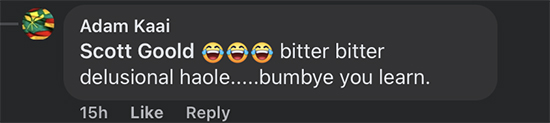
I was responding to Kaliko Castille, in a social media conversation on Hawai'i Governor Josh Green's account.
Kaliko wrote, "Scott, The Republic of Hawai’i was not the legitimate government under international law — it doesn’t matter what U.S. politicians said. Your problem is that you lean on constitutional law but then can’t show how a joint resolution has any extraterritorial effect beyond U.S. borders. [NOTE: read my book where I explain]
To Kaliko, I wrote, "Queen Lili'uokalani officially recognized the Republic of Hawai'i as the legitimate government of the Hawai'i islands in 1895. The international community did as well. You can post convenient lies on social media, but cannot change the facts of history."
Adam Kaai jumped in and referred to me as a "bitter bitter delusional haole."
Elija claims White people "haoles" have a "pre-existing entitlement." He provides no proof. The ONLY entitlement I observe in the islands is the FALSE BELIEF that one does not need to SECURE a good-paying job that allows the person — "not blood alone" says Adam — to afford a suitable place to live and raise a family.
In Elija's courses, he claims “We teach them how to behave, how to coexist with a culture that has been here the longest, how to advocate for that culture and empower the people from that culture. But you cannot even get there if you don’t understand trauma, or historical context, or Hawaiian values."
Hawai'i is land of many cultures. The successful resident becomes aware of Japanese, Chinese, Filipino, Native Hawaiian, Pacific Islander, American culture and more. That's aloha — when all of us appreciate what each of us bring to the table. Aloha does not advocate for one culture over another.
Adam takes a more cynical view, "Settlers must ask: Am I making space for kānaka leadership? Am I redistributing my access and wealth? Am I confronting the systems that benefit me at their expense? How am I helping the community? They must have uncomfortable conversations. Singing the ho’oponopono prayer on a beach in Kailua with Elijah does not do that."
"Kānaka leadership?" Islanders tried that beginning with Kamehameha. Kanaka population collapsed to 40,000 from some 800,000+. Monarchy fell to corruption and infighting. Due first to territorial annexation in 1898, then statehood in 1959, Hawai'i is one of the most vibrant places to live in the world.
Adam demonstrates his sense of Kanaka entitlement, as he asks of the White American, "Are you redistributing your access and wealth?" King Kamehameha the Great could answer such a question, "Sure! What can you do for me?"
Scott Goold, PhD
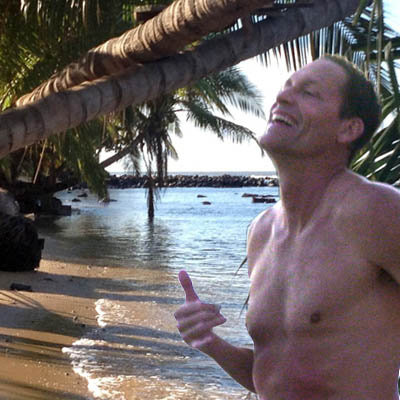
Scott Goold, is a White American, also known as Mr. Aloha and affectionately annointed King Kama'aina, because NOBODY can dethrone the king in debate or discussion.
The Hawaiian gods summoned Scott to the island of Kaua’i to learn and then spread the truth about the promise of aloha — a promise for the entire nation and world: that peoples of different races and creeds can live together, enriching each other in harmony and peaceful self-governance, to further Life, Liberty and the Pursuit of Happiness.
Scott now fulfills the Prophecy of the Hawaiian gods: that a righteous king will come to bring truth to this land.
Ua Mau ke Ea o ka ʻĀina i ka Pono
The life of the land is perpetuated in righteousness
Elija and I align similarly in many ways. Elija believes there are three fundamental principles of Hawaiian spirituality: Aloha 'Aina (connection to the land), Aloha Akua (connection to spirit) and Aloha Kanaka (connection to one another).
I believe Elija is incorrect and outdated on the last principle: "Aloha Kanaka." Possibly ancient Kanaka believed this way — prior to contact with the global community. Aloha, like the concept of love, was never meant for one group of people. Aloha is universal, as is love.
The third principle therefore must be restated simply as "Aloha" — connection to one another — all of us. None can be superior; none inferior. Aloha and love are the universal bonds that bind us together. And Hawai'i is the source and center. Elija is absolutely right about that.
Adam speaks of dispora, "half of Hawaiians live in the diaspora because of settler colonialism." This is an unfortunate Convenient Lie told by Kanaka today. I need to set this record straight here and now.
When British explorer Captain James Cook arrived in 1778 on Kaua'i and Ni'ihau, there were an estimated 800,000+ Native Hawaiian (Kanaka) in the islands. By 1893, when the queen was removed from power, only 40,000 Kanaka remained. That's the real dispora of Kanaka people — due to wars of Kamehameha and the monarchy's agenda to bring the outside world to the islands, diseases of the world arrived as well. Some 95% of Kanaka perished.
It's estimated today there are about 450,000 Kanaka. Adam claims half live in dispora outside the islands. First, that means of the 40,000 Kanaka in 1893, there are now around 225,000 Kanaka residing in the islands. This is over 560% growth in island Kanaka due to territorial protection and U.S. statehood. Including those on mainland or other parts of the world, total Kanaka resurgence has grown over 1,125%.
Adam is angry. He apparently believes ALL Kanaka (1) want to live in the islands, and (2) have a right to live in the islands. Many Kanaka have benefited moving to mainland locations to find more challening employment, better schools and other oppportunties. Not all Kanaka want to live on "the rock," as they say.
Second, life does not promise us a living. The world does not owe any of us. Kamehameha and his armies relocated Kanaka as he sought fit. He killed to conquer and control. There is no precedent in the islands for entitlement based on ancestry or blood.
Living Pono
Elija stated, "Pono means alignment, to be in balance, to live with integrity." I would add pono means living in righteousness, as I quoted initially. Adam added “Pono is about restoring balance. You can’t restore balance by denying what was broken. You restore it by acknowledging your role in the system, by listening, by giving back land and power, amplifying Hawaiian issues, and by acting in solidarity.”
The healing power of aloha is more evident when listening to Elija. Adam's anger distorts his messaging. "Broken?" I argue that the Kalākauas "broke the social contract with the local people." The Kamehameha dynasty recruited, invited and partnered with outsiders. The price of their more advanced technology and global systems was land and political power.
The Kalākauas violated that social contract, i.e., David and sister, Lydia Liliʻu Loloku Walania Kamakaʻeha. This breach of contract resulted first in the forced 1887 constitution, and the overthrow of the queen in 1893. David Kalākaua had agreed to the restraints. Had Lydia acquiesced she would have ruled the islands like Queen Elizabeth ruled England — powerfully and respected, although in diminished legislative capacity.
Readers must remember that Queen Lili'uokalani proposed to fund the Kingdom of Hawai'i using a national lottery and taxes on the sales of opium. We know that lotteries tend to take more money from those who have the least, and no serious official economist in Hawai'i today would support sales of opium to fund schools, roads and the needs of the common people. Lydia Kamakaʻeha's understanding of public finance was broken.
Cultural Conflict
Adam wrote, "I looked in the comments and saw a lot of combativeness between Hawaiians and non-Hawaiians. Maybe a haole would do something ignorant and they filmed it and it goes viral, now the whole Hawaiian community is coming after them. They didn’t mean it, but that’s what happened. I can understand because I’m a human, and I make mistakes. There was a disconnect of education and awareness."
Calling a White American "haole" is like calling a Black person "nigger" or Native American "injun." Conflict begins when people slur other people. Adam provides no example of White Americans disparaging Kanaka. The combativeness is one-directional: from Kanaka toward White Americans.
Kanaka believe their land was stolen. They blame White Americans, and this attitude weakens the Kanaka and continues hatred. Kanaka have forgotten the true meaning of aloha!
SEE MORE:
Convenient Native Hawaiian Lies
Adam Keawe Manalo-Camp

Adam Keawe Manalo-Camp is a Hawaiian cultural historian as well as the president of Indigenous Pasifika. He is also a published writer, blogger, podcaster, researcher and administrator of the Facebook group “Hawaiian History and Culture” — which is the largest history group on Facebook with more than 27,000+ members. Adam is currently the Secretary and Outreach Coordinator for Affirmative Action Committee of the Democratic Party of Hawaiʻi. He is of Kanaka Maoli (Native Hawaiian) and Filipino (Ilocano and Kalinga) heritage.
Adam told Eric, "’Settler’ is not just a neutral descriptor. It names a relationship to privilege, power and land. It refers to someone who moves to a place already inhabited, often benefiting from systems that displace the original people. It’s not about where you were born, but about whether your presence contributes to the ongoing displacement or restoration of the Indigenous people.” He added that the concept of a pono settler is inherently flawed, "There is no truly pono way to occupy stolen land."
Scott laughs, Adam seems very angry and anger is the mind killer, as they say. If we look at the migration of Europeans to North America beginning with the Pilgrims in 1620, nobody can claim these initial settlers had a privileged or power relationship to the land. They were fleeing persecution. Only about half of the initial 102 settlers survived the voyage and the brutal first year.
The first non-Polynesian settlers to arrive in Hawai'i were missionaries who landed in 1820 on the Thaddeus from Boston. There were a dozen waves to follow through 1848. They came to spread the Christian gospel among the Hawaiian people, established schools, created the written ʻŌlelo Hawaiʻi, translated the Bible into the Hawaiian language, and introduced western education, arts, sciences along with concepts of moral values.
The missionaires settled at the privilege and permission of the kings. The monarchy sought to become part of the global world of commerce and interaction. The missionaries were their "consultants," if you will. And in trade, the kings gave them land and positions of respect and authority. This relationship formed a complex social contract. Both sides benefited.
Adam told Eric, "People often hear this and think it means 'you are a bad person just for being here. That’s not the point. The point is: the land was taken and half of Hawaiians live in the diaspora because of settler colonialism, and no amount of yoga stretches, pink pussycat hats, rainbows and good intentions erases that foundational violence."
Scott disagrees, This is the Convenient Lie told by Kanaka in the islands. Land was never taken. It's still here, as it was for 1,000s of years ago. Kamehameha marched to war beginning in 1782 to put management of the land under his control, which he accomplished in 1810. The monarchy ruled and profited from the land until 1887. Local business leaders revolted due to the high taxes and corruption of King David Kalākaua and forced a new constitution on the monarchy. The legislature now governed the island archipelago.
With Kalākaua's death in 1891, his sister Lydia assumed the throne under the name Queen Lili'uokalani. Local people and the business community were pleased with her ascent to leadership. However, in late 1892, the queen demanded a new constitution — that would restore power to the throne, as well as weaken legislative control over government taxation and spending. Local leaders removed the queen from power and established a new government in the islands.
The land was still here. Land was never taken. If Adam's great ancestor had received 100 acres of land from Kamehameha III, then Adam would still own that land today. What changed hands was ownership of the crown lands, the lands controlled by the monarchy and associates of the kings and queens.
Becoming Tribal
Adam concluded, "You can be haole and for the lāhui, just as you can be kānaka and not be for the lāhui. It’s not blood alone — it’s where your values and actions are aligned as well as recognizing your position to power and privilege. But being for the lāhui requires humility, accountability and the willingness to be uncomfortable. It’s not a sticker or identity. It’s a practice.”
Referring to White people as "haole" is a racial slur, as I've mentioned previously. Adam doesn't have a racial label for other groups — just White Americans. However, some social researchers claim Japanese in Hawai'i generally are for the Japanese, Chinese for the Chinese. Filipinos support the Filipino community. White folks tend to support White groups, and Kanaka may prefer to stand for their lāhui.
Adam speaks about "the lāhui" or the Native Hawaiian nation. His opinion, right? As an American, I frequently speak my nation — the United States of America. My speech is protected under the First Amendment and we are a nation of laws — beginning with the U.S. Constitution. When Adam speaks of the Kanaka lāhui, other Kanaka may or not agree, as he suggests.
It's the OPINION of Adam that being FOR the lāhui requires "humility, accountability and the willingness to be uncomfortable." Other Kanaka may or not agree. If I said, being FOR the United states requires "humility, accountability and the willingness to be uncomfortable," some people might laugh; others might cheer. One thing I know about Kanaka is that individually, they have as many opinions about their lāhui as Americans have about our nation.
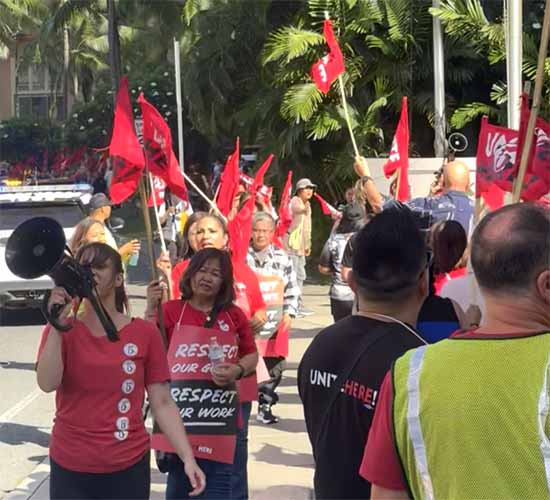
Local 5 demonstrating at the Ilikai hotel in Waikiki. Mostly Filipino laborers fighting for higher pay and better conditions for all workers.
Ultimately, Adam's position confirms my claim that WOKE Hawai'i has become Tribal Hawai'i, and WOKE Hawai'i triggered the rise of MAGA and Donald J Trump.